
From 68 Words to 4,861: How Mind Mapping for Writing Changed My Writing Forever
- Maneesh Dutt
- 0 Comments
- Uncategorized
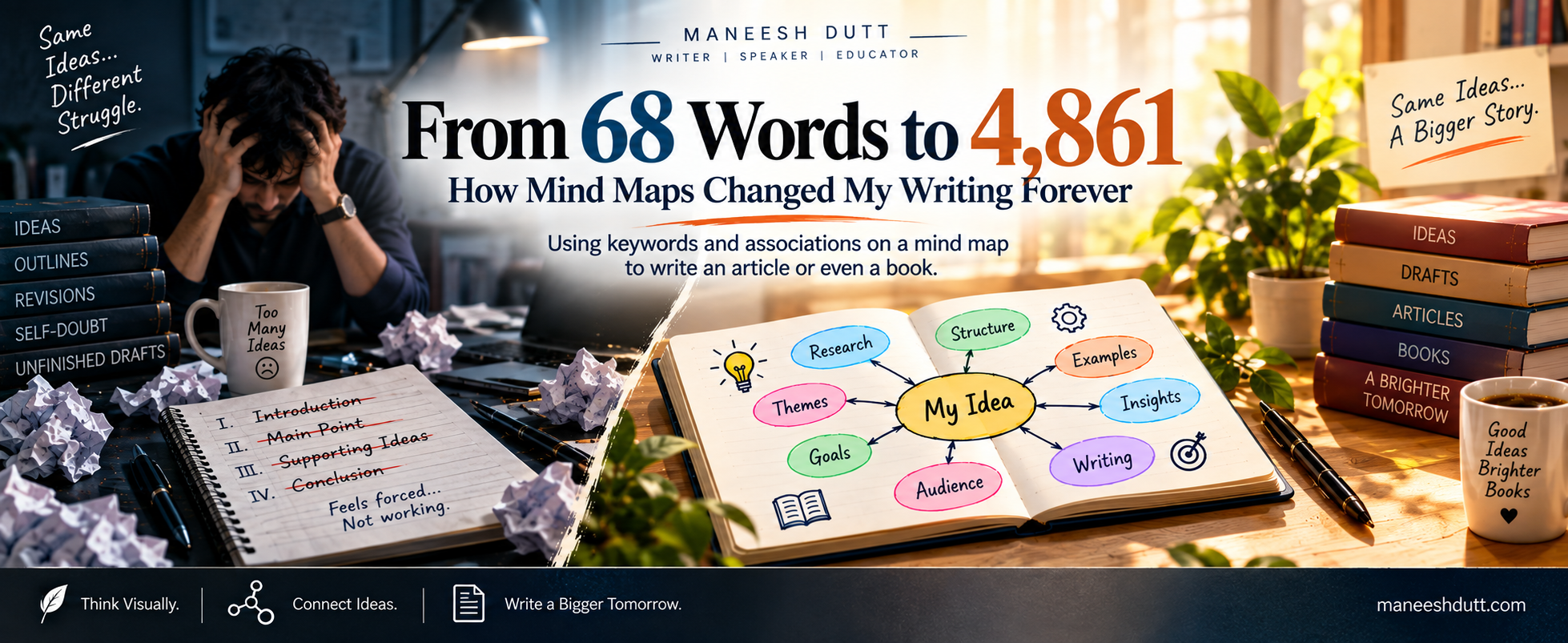
I always assumed writer’s block meant I was running dry on ideas. Turns out, it was the opposite for me; I had too many, and no way to hold onto them without exhausting myself in the process.
I’d try to outline everything first, you know, Roman numerals, little sub-bullets, the whole neat-and-tidy structure we all got taught in school. But the human brain simply doesn’t think in straight lines specially during the creative phase. When you brainstorm, your mind leaps around associatively. Trying to force those spontaneous leaps into a rigid outline while simultaneously trying to write full sentences creates massive cognitive overload. That mental friction is where I think my writer’s block actually came from.
Anyway, the thing that changed everything for me was this one article I had to write for a journal. That was when I decided to abandon standard outlining entirely. Instead, I adopted Mind Maps. For me, mind mapping for writing became a way to capture ideas visually before trying to turn them into full sentences. I drew a single central node on a blank sheet of paper and let my ideas radiate outward in a visual map; no numbering, no pressure to decide what was a “main point,” just whatever came to mind, connected to whatever it was related to.
When I finished that visual brain-dump in the form of the mind map, I went back and counted the words on the page: exactly 68. Sixty-eight words, and somehow, they held more of the article than any outline I’d ever managed to force onto a page.
Yet, looking at that mind map, I didn’t see a bare outline; I saw a complete, connected roadmap. The way the branches sat next to each other made the flow logical. A single branch with just a few keywords was enough to spark pages of clear writing. And most importantly it surged me with a new boost of energy to complete this writing project in which the start and end were so clearly visible.
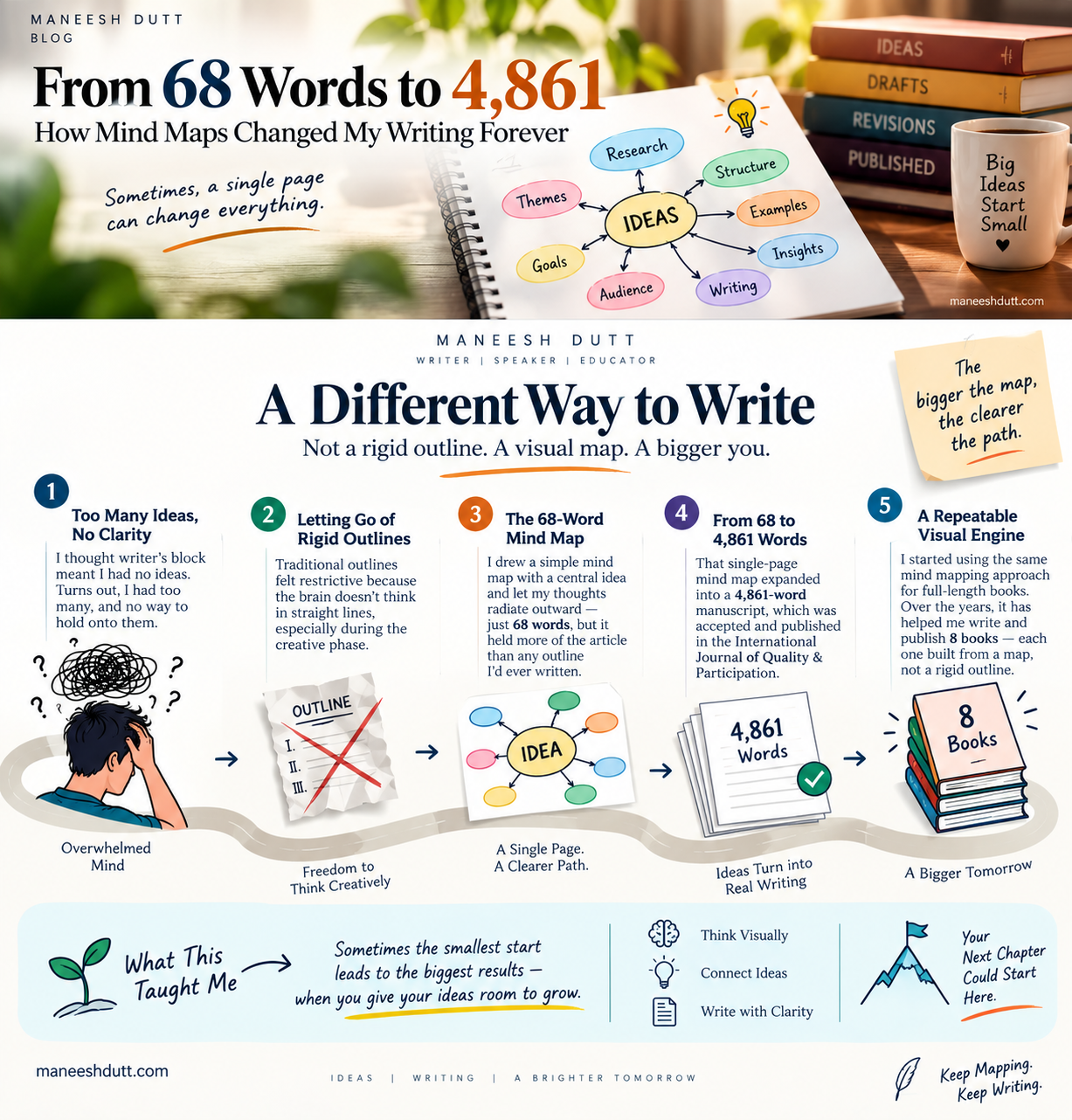
That 68-word mind map expanded into a 4,861-word manuscript that was accepted and published in the International Journal of Quality & Participation.
Seeing that nearly 70-fold expansion from a single page made me realize I had stumbled onto a repeatable visual engine. I started applying the same approach to full-length books, not just articles. And again, the results surprised me. Over the years, this same visual workflow, mind mapping for writing, has helped me write and publish 8 books; each one built the same way: not from a rigid outline, but from a map that grew wider and more connected the longer I worked on it.
That led me to the 3-Step Author Transformation Framework.
If you’re writing a book and feeling blocked, this might be exactly what you need.
Discover my 3-step process here: https://maneeshdutt.com/new-author-support/
More about the 3-step process in my next blog. Stay tuned!